Showing posts with label Australia. Show all posts

Saturday, 9 June 2018

Our Blue Mountain Hideaway: World Cup 2018 Russia

Our Blue Mountain Hideaway 


The final part of our Australian road trip odyssey was to travel back towards Sydney through the Blue Mountains National Park, staying for 2 nights in the very heart of the park in Katoomba. We have seen a lot of dusty outback on this trip and now it was time to head back towards the coast and see something a bit different. We knew that the scenery would change significantly but what we had overlooked was that it would also be a lot cooler in the mountains and as we got closer to our destination, both a light drizzle and the temperature started to fall.  We arrived at our campground in the half-light of late afternoon and did some much-needed laundry before heading to get a glimpse of the Blue Mountains before sunset. It was cold & wet but it was not disappointing....

The following morning was brighter than the previous evening, but still in single digits on the temperature scale when we awoke, and so we got up early to make the most of the day. Our campground was literally on the edge of the plateaux overlooking a series of deep canyons and the impressive Mount Solitary, and just around the corner from Scenic World, a sort of amusement park for nature-lovers, which is where we decided to head.


Scenic World has a couple of interesting attractions; firstly it has the steepest railway in the world, first built by coal miners in the late 1800’s; secondly it has an impressive cable car that swings out over the deep valley floor; and it has a cableway that descends the 270 metres down to the forest in the valley below. When you get down to the forest there are a bunch of elevated walkways you can take that wind through some very impressive and untouched scenery which has not changed since Jurassic times. Fiona & I had a heap of fun spending the morning riding down the
cableway, doing the forest walks below and then coming back up on the railway before shooting off to do the cable car over the Katoomba Falls. After lunch, we did it all again, but this time in the reverse order, going down the railway, (quite a different experience to coming up the railway, let me tell you), and back up the cableway , we even threw in a few more cheeky rides down the railway for good measure before calling it a day and heading back to the van for our last night.

The Blue Mountains area was awesome, and I think it would have been nice to be able to stay another night, but we had to pack up our stuff and clean up the van before driving into the heart of Sydney to return it. It was another overcast and damp morning when we awoke, but we had a cup of tea, used up the last of our breakfast cereal and dug out our backpacks and started the packing process. We were all set by 10:00am and had plenty of time before we need to start the trip to Sydney, so in good kiwi fashion, we stopped off in town for a second breakfast of pancakes,... Yum.


The Camper return location was not far from Sydney Airport, where we had a room booked at an airport hotel, in preparation for our 6am flight the next day. The drive into Sydney got progressively worse, both in terms of weather, it started raining hard, and the traffic was just mental. I guess if you swan about in a van in the outback, where you wave pleasantly to passing drivers because you just don’t see that many of them, driving into Sydney in the rain on a Tuesday morning in a 7m long camper van, things are going to feel a bit stressful, and don’t worry, they were....  The only time that I felt at risk throughout the whole of the 3,700kms that we drove was the last 15km in Sydney traffic, which is something I don’t wish to repeat in a hurry....  But we made it safe & sound, and regretfully handed back the keys to what had been our home for the past 2 weeks.

Overall the van had been very comfortable and was fully equipped with everything we could possibly want, and more. We found it quite spacious inside and we also enjoyed using the outside space, (with provided table & foldable chair), with enthusiastic use of the roll-away outside grill for almost all of our cooking. We are going to miss our rolling home, and I would most definitely recommend & encourage people to hire this sort of camper for any extended trips to Australia its a great way to see the country, (skip rainy days in Sydney), and I feel certain that this will not be the last time we do this. It is expensive, but you get what you pay for.

We checked-in to our airport hotel, (literally 3 minutes walk from Departures), used up the last of Australian cash in the hotel sports bar, and hunkered down for an early night, as we had to be up at around 3:00-4:00am to make our flight for the next part of our Adventure.... Russia, here we come...


Thursday, 7 June 2018

Heading East : World Cup 2018 Russia

Heading East : World Cup 2018 Russia


As we had spent quite a bit of time in Uluru, Coober Pedy & Port Augusta, and we wanted to have a couple of nights in the Blue Mountains before hitting Sydney and the airport, we now has a few days where we needed to get some distance under our belt. Instead of heading further south to Adelaide, Melbourne and back up to Sydney, we wanted to continue our flirtation with the dusty desert and had planned a route heading almost due east from Port Augusta, skirting along the edge of the boarder of civilization and the vast empty outback for a few more days.  

Our first target overnight stop was in a historic mining town called Broken Hill some 400kms east of Port Augusta, so we packed up early, well early for us, and hit the road. Leaving town we passed many farms and orchards lining the road as we crossed over the foothills of the Flinders Ranges and beyond. Soon though the neatly arranged crops and fields gave way to dusty scrublands and the all-too-familiar red earth that we had been seeing ever since we set off from Alice Springs, and it wasn’t long before we felt like we were back in the outback. Long days at the wheel can be fun regardless of how repetitive they may seem, and Fiona & I enjoyed the ever-moving scenery, accompanied by a rotating selection of our favourite podcasts, (Judge John Hodgman & ‘My Dad Wrote a Porno), interspaced with long talks about life, the universe, and everything.

We arrive into Broken Hill in the mid-afternoon and found somewhere for a late lunch before heading to my favoured campground to see if we could get a spot for the night, and even though they were extremely busy, we managed to get a powered site for the night and settle in. I can honestly say that even though this small mining town on the frontier between the working farmlands of the coastal hinterland and the barren wastes of the outback, may have seemed a bit quiet, it had a lot going for it, and this was going to be one of the many places we had visited that I wish we could have spent longer in. We had seen that there was a desert sculpture park on the outskirts of the city and we resolved to rise early, leave the campground and visit the park on our way out of town, and have breakfast on the road. We managed to rise early and get on the road, but we had not factored in that the warmth of the sun had yet to kick in as we stood on a breezy hilltop looking at both the sculpture and the impressive vistas, demonstrably freezing our arses off. Even the local Kangaroo population were too cold to hop away from us, so apart from our new marsupial friends we spent an enjoyable 20 minutes alone before we retreated to the van to warm up.


We had a lot of ground to cover to get to Cobar some 460kms further west and we settled in for another 5 hours drive, but at least we have a cooked breakfast of a bacon & egg sandwich to look forward to at our first stop of the day. The kilometres seemed to pass effortlessly in our unstoppable Mercedes Sprinter camper, which considering its limited space was surprisingly comfortable and enjoyable to spend time in, and it was as reliable as we have come to expect of superior German engineering. It was another afternoon of finding a campsite and then making ourselves at home for the evening. We really didn’t see much of Cobar which is a bit of a shame, but you never know when we might come back this way. We made the most of an early start and finally started heading back to some semblance of civilisation, towards the city metropolis of Dubbo via the interestingly named Boganshire...! I honestly thought that the word ‘Bogan’ was a derogatory name that others used to label Australians, but it seems to be an actual place,... Who knew..?


The ride to Dubbo was a shorter one so we had some time to spend an afternoon in the city of only 39,000 people, with the campground was just a short walk to the centre of the city and was as comfortable and relaxed as any of the places we had stayed in before, except this time with actual green grass.  We found a small Vietnamese restaurant for a spot of lunch and spent the rest of the afternoon exploring the Old Gaol complex which was remarkably well preserved, not surprising as it was in use until 1966...! We took a slow saunter back to the van, before planning for our last few nights in the campervan and our trip to the Blue Mountains.

Saturday, 2 June 2018

Reaching the Ocean, almost....

Reaching the Ocean, almost.... : World Cup 2018 Russia

When you are on the Stuart Highway heading south, after Coober Pedy there is little opportunity to head anywhere other than towards Port Augusta, a small town situated on the very northern end of the Spencer Gulf, that eventually leads out to the Great Australian Bight, or as close as damn it, the Southern Ocean.  It was another 500km plus driving day to get us down to Port Augusta so we booked into the campsite for 2 nights so that we could have a rest day and explore the area.

The trip was another 5 hours of ever-changing scenery, from the long dusty plains out of Coober Pedy, through the wild outback desert, past the vast inland salt lakes and the Woomera test range, a facility that supported the British nuclear bomb testing in the 1950’s. Eventually, as we descended a number of great escarpments we arrived on an arid coastal plain of marshes and swamps at the head of the Spencer Gulf. It had been a long day at the wheel so we pitched up at a nice looking campground and settled in for the night.


With no great plans for the day, we ate a leisurely breakfast and headed into Port Augusta, on what was a warm and pleasant day. We found a good spot to park ‘Dilbert’, (no mean feat with a 7m/21 foot van) and took a wander around the small town. It had once been a great port with massive docks and several jetties but with the arrival of the train and motor car, and a bigger port further south towards Adelaide, Port Augusta was now a sleepy little town on the water’s edge.  

We had a very enjoyable couple of hours following the heritage trail, reading up on the history and sitting on the old wharf before heading to the Australian Arid Lands Botanic Garden for a spot of lunch, which came highly recommended. After eating we sat in the gardens enjoying the warmth of the pale winter sun and then went to the overlook to view the distant Flinders Ranges, thinking that very little had probably changed to the view since Mathew Flinders sailed up the Spence Gulf just over 200 years ago.

We jumped back in ‘Dilbert’ and went on a short adventure into the Flinders Range to a small town called Quorn, which looked like just what you would expect an Australian country town to look like from the 1800’s. We took a look at a small railway museum and then around the old buildings scattered about this small town before going into a typically Australian county hotel bar for a drink and a chat with the barman. 

He was a font of information about the town, in particular, all the films that had been made in the area, and in fact filming was about to start in the next few days for another of those Australian country drama’s that seem to pop up on NZ TV so often. We meandered our way back through the hills to Port Augusta and settled in for the evening, as we were going to have an early start the following morning as we turned East and headed towards Sydney over the next week....

Friday, 1 June 2018

Welcome to Coober Pedy

Welcome to Coober Pedy: World Cup 2018

Coober Pedy looks exactly like what it is, a dusty frontier mining town sitting in the middle of a desert plain and while this is the largest settlement for almost 1,000 kilometres, it just looks barren & empty. We cruised into town and found the campsite we were going to stay at and checked in for 2 nights, quickly setting up camp in a now well-practiced fashion. 

It was late Sunday afternoon, and that evening the campground had a 2-for-1 deal on Sunday Roasts in their restaurant and Fiona & I were not going to miss out on the chance on that tasty deal. Fiona went to the bottle shop and scored a six-pack and we enjoyed the rest of the warm sunny afternoon at camp before we took advantage of the offer of a roast dinner. Like with any form of camping, once the sun goes down, there isn’t a whole else you can do except for heading to a bar, but we were not in that kind of mood, so we took advantage of another early night.

The previous evening we had signed up for an afternoon tour of Coober Pedy, so we lazed around during the morning, taking a long walk along a short main street, and ended up having a coffee at a petrol station. We duly went to wait for our tour in reception, where we met a former Greek émigré Dmitri, now known as Jimmy, a dapper small framed man would be our tour guide for the afternoon. Even though Jimmy had been in Australia for the thick end of 55 years, he still maintained a thick southern European accent that was on occasion difficult to decipher. Anyway, we jumped in his mini-bus with a bunch of other guests and set out on a tour of the highlights of the town and some of the surrounding area.

I can honestly say that I can’t remember going on such a fascinating tour with such an interesting guide. We started out at the underground Serbian church which was hewn out of the local sandstone and gypsum by local miners, complete with hand-carved statues by a famous Kiwi sculptor, and even on this warm late autumn afternoon, it was refreshing to slip underground where the temperature hovers between 22-25’C year round. Jimmy joked around that he sometimes stood in for the priest, and that he was good friends with the sculptor, he certainly knew his local history. 

Apparently, Coober Pedy is famous for its underground homes, which would explain why it seemed that there were not many houses around, but if you looked closely, you could just pick out the ventilation shafts dotted around the rocky landscape, giving away the position of another hidden home. The temperatures in this place reach a staggering 50’C in the heat of summer, and therefore living underground has almost become a necessity, and given that the majority of people that live in Coober Pedy are involved in the opal mining business, it makes sense that they use those skills to build their homes.

We took a trip to a former opal mine firstly to view how the underground houses were laid out, and then further down to see how the mining was performed. Jimmy told us that this was once one of his mines and showed us where he and his brother used to dig, and where they found the opal. He was certainly a bit of a character, but I wasn’t sure whether this was part of his tour guide routine or for real, but everyone we met as we wandered the mining exhibition knew him on first name terms, or as ‘Jimmy-the Runner’. It seems that he had a reputation for both setting short fuses and getting clear quickly when blowing a mine, and also for being a charity marathon runner, I’m not sure which one was true. At this point, I started to get an inkling that Jimmy was some sort of local legend especially when I saw his photo in a book at the gift shop, whoever he was he was a character.

We next drove out of town into the mine working where we saw hundreds if not thousands of deep mineshafts which have been sunk on speculation to find the elusive opal. Opal is formed from silica-laden water seeping into cracks in the sandstone, or into the voids left by dead animals or shells, like how fossils are formed, and solidifying into the opaque precious stones we know today. As this process is dependent upon where cracks form and how and where sea creatures die and get trapped in sediment, there is literally no way of being able to know exactly where opal might form, so each of the many hundreds of thousands of mineshafts sunk out there was a lottery, and if you found opal, you were extremely lucky. Jimmy showed us a few of his old mines and told us old stories of friends that had died in cave-ins or falls, or a very few that had survived but moved away from mining. Jimmy had had a recent battle with cancer and since beating that terrible disease had given up the mining for being a tour guide. Both Fiona & I thought that given half a chance he would be back down a mineshaft quicker than you could say “Crikey”...!

From the mining area, we went out into the desert area to see the famous Dingo-Proof Fence, which stretches over 5,600km from South Australia to New South Wells, an unbelievable feat of engineering which is still kept up today. Then we went to the Plains of the Moon to watch the sun set over what was the bottom of an ancient seabed many millions of millions of years ago, strewn with foreign rocks transported by a long-vanished glacier. It was a stunning vista of golden reds and flaming oranges as we watch the sun finally dipped beneath the horizon, accompanied by wine and nibbles, all very refined and dandy. From here we headed back into town in the dying light to end the tour at the Desert Cave Hotel for a drink and a wander through their underground museum. Overall the tour was a great way to spend an afternoon in this strangely odd but alluring town of Coober Pedy, and I recommend it to anyone that comes this way through Australia. Un-missable.

We wandered back to our campground to make our dinner, drink another beer and reflect on what had been a great day, one that we would not forget anytime soon.


Thursday, 31 May 2018

The Long Ride South:

The Long Ride South: World Cup 2018

Now you probably know that Australia is a big place and that to get anywhere takes an age, well we were just about to find this out for real. Our next destination was the Opel mining town of Coober Pedy but from Uluru, it was just too far to drive in one hit, so we decided to have a leisurely start and then break our journey somewhere near the South Australian border.

We took our time getting up and having breakfast, nipped to the supermarket for some supplies and a coffee, then went to the get diesel at an astronomical price, (yeah, yeah, we are in the middle of a desert, I know), and finally started the trip south. The first part of the trip was retracing our steps back to the Stuart Highway some 244km before we turn towards Kulgera, which would be our stop for the night. Kulgera is the very definition of a one-horse-town, there is literally the Roadhouse & petrol station, a campground and a police station, if there was any more to this outback metropolis, they were doing a very good job hiding it.
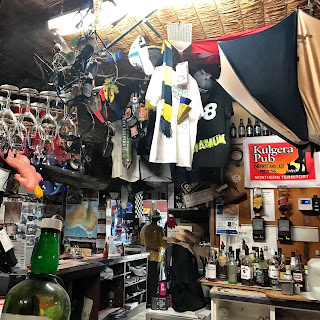

It's a small world sometimes, the guy that checked us in was a Kiwi
from Addington. He told us where our spot was and where the shower block was and that happy hour in the Roadhouse was from 6 to 7pm, so just the important stuff. We set up camp and chilled out after a long drive, before heading off for a happy hour beer or few in the quirky Roadhouse bar, before returning to our wheeled home and making some dinner and turning in for the night. We had another 400km + day driving day tomorrow, so we wanted to make a reasonably early start.

It's obvious to me that we are just novices at this camper/caravaning thing in comparison to the Aussies who do this sort of trip all the time because even though we got up early, showered and ate breakfast to get us on the road, we were still almost the last people to leave the campsite that morning. We have a lot to learn... 

The Stuart Highway that runs between Adelaide & Darwin is a smooth 2 lane stretch of bitumen, so I locked the cruise control at 90kph and followed the white lines for kilometer after the kilometer. The Outback is vast, a vast empty plain of almost nothing but sand & rocks and desperate vegetation. You travel along unbelievably long straight sections of roadway with nothing but stunted shrubs and dusty trees for as far as the eye can see, no people, no buildings, no features and hardly any other traffic. I was expecting to see some wildlife along the journey, maybe some dingo’s and the ubiquitous kangaroo that Australia is so renowned for, but the only wildlife we saw were dead at the side of the road, sheep, cows, and kangaroos, the only living things were saw were the crows pecking at the carcasses.

Another interesting sight along the highway was the mangled wrecks of cars that had obviously had an unfortunate interaction with the pre-deceased wildlife, and after a while Fiona & I started to wonder if these were left here as a warning to other road users, if so, it was a pretty sombre reminder that these roads could be dangerous. As you move towards a subtle rise in the landscape you wonder what you might be able to see on the other side, only to crest the hill and see even more of what you have been looking at for the last 100kms. Occasionally, the landscape will change almost imperceptibly and where there were short desert oaks and wild shrubs now there are only shrubs, with not a tree in sight, then before you know it, it was back to dusty trees. This went on for hours as we cruised steadily south, counting down the endless kilometers towards our destination.


We could tell we were approaching the World Capital of Opal mining when about 30kms away from our destination when small pyramids of dirt started to appear on the skyline, followed by more pyramids and bigger piles of multicoloured dirt until the whole of the landscape both sides of the road was covered in them. Then we started seeing the occasional piece of mining equipment or an excavator in a hole, and signs marking out mining access points, and finally, we could just about make out a few building in the distance. Welcome to Coober Pedy.

Sunday, 27 May 2018

Uluru Magic

Uluru Magic: World Cup Russia 2018

Wednesday was going to be a busy day,... What with checking out of our hotel, picking up our Campervan, dropping off the rental car, and provisioning for a week in the Outback, and then leaving Alice Springs and driving 450kms to Yulara. But like with many good plans, everything fell into place like clockwork, and by 11:00am we were doing some hard mileage in the van. I think both Fiona & I were a little nervous about driving this 7m long behemoth of a campervan at first, but as the road slipped behind us, we soon got used to it. The road was long but scenic with a few stops along the way, the main one for coffee, but by 5:00pm we rolled into our campground 

After this long drive and our first cooked meal in the Campervan that we are
now re-naming to ‘Dilbert’, we got ourselves ready for an early night. Converting the seating area into the bed was more effort than we both would have expected, and then making up the bed with sheets and duvet’s seemed intensively laborious, but once we were finally in the bed, we soon drifted off to sleep.... So whilst sleeping in a campervan is significantly better than sleeping in a tent, it shares some of the initial discomforts and niggles, especially on the first night.  Trying to find a comfortable position was a struggle at first, and as you can imagine, every time I rolled over the van would move with me a little, and I am sure that Fiona was dreaming of earthquakes. I woke a few times in the night to try and find a better position, but even though it was rather cold, I think we were both warm enough and overall got a reasonable nights sleep. 

We were both awake early but as it was so cold it was a struggle for us to get out from under the warm duvet, so we didn’t surface for a couple of hours. For those of you that regularly travel in a campervan, you will fully understand what I mean when I talk about the intricate ballet that has to be performed by 2 people sharing such a confined space and believe me, this was not as small as it could have been. If we both started moving about at the same we would end up either bumping into each other or various cabinets or drawers, so I reluctantly stayed under the duvet while Fiona made breakfast, but after negotiating our complex dressing maneuvers we managed to get ready to head into the Uluru / Kata Tjata National Park.

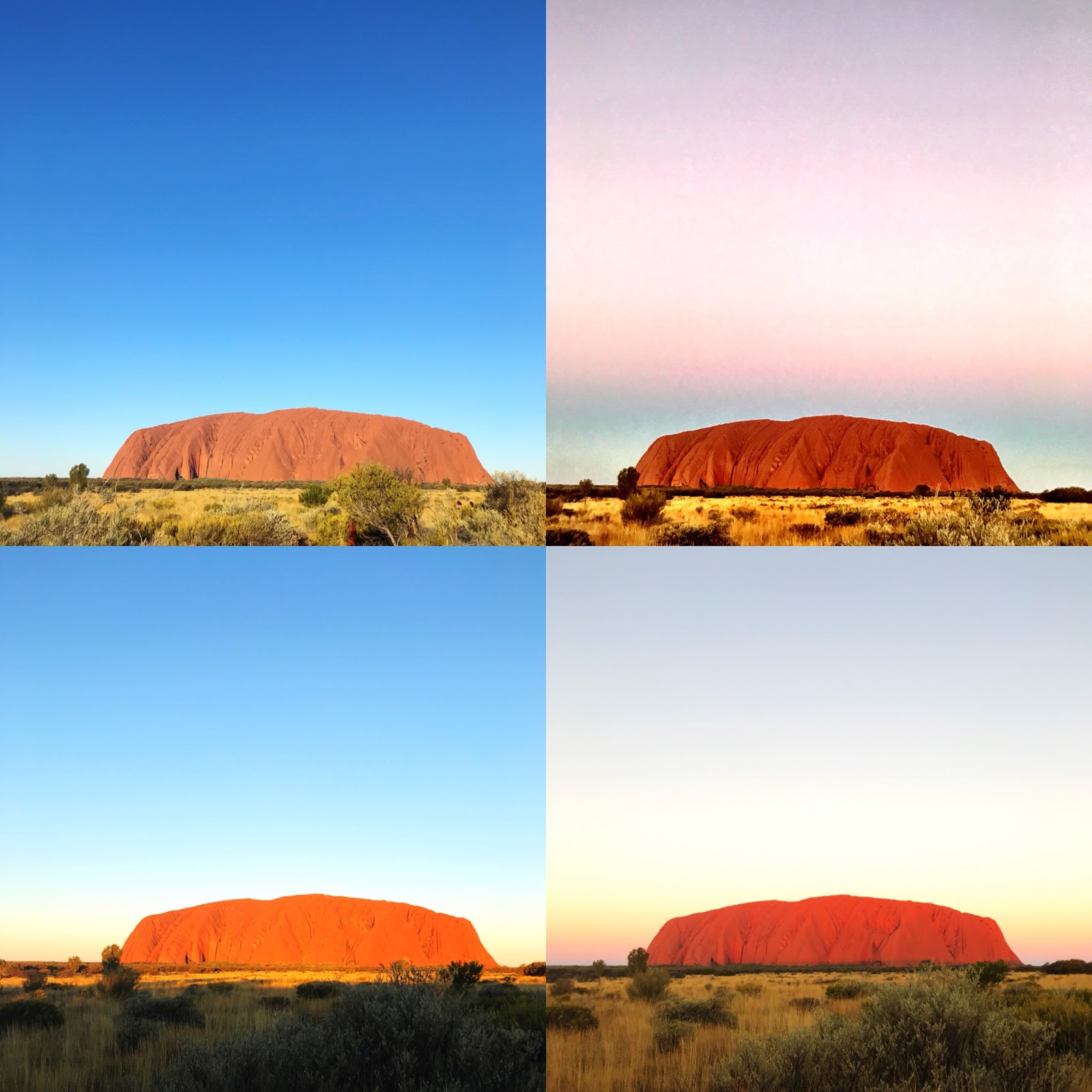
Dilbert cruised briskly through the park gates and along the winding roads between the dunes towards the imposing orange monolith called Uluru, once known as Ayres Rock. As we got closer it didn’t matter what angle you viewed it from, some new detail, shape or colour would present itself. We headed to the Cultural Centre to get a flavour of what this sacred place meant to the local indigenous peoples and learn something of the history before jumping back in the van to get up close and personal with the Rock. We first visited the sacred waterhole and then the sunrise viewing spot, then completing a full circuit before stopping for a spot of lunch. This is where traveling in Dilbert comes into its own as we just pulled over into one of the many viewing areas and made up our lunch. As it had taken so much effort to make up the bed the night before, we had not bothered to take it down, so we luxuriated in the back for a while eating lunch before heading out on another circuit, this time with Fiona driving so I could get a good view.

We wanted to get a good position for the sunset later that evening, but we also
wanted to do a few night-time activities that needed to be booked, so we headed back to Yalara. Fiona booked us into a guided Astronomy tour for that evening, and a light display the following evening, after which we tooled around for a short while before heading back into the park again. We got to the designated sunset viewing area nice an early and early and pulled out our sliding BBQ and started making Dinner so that we could have it and watch the sun go down. I am beginning to like this campervan thing....

As we prepared a chicken salad, the car park started to fill up and by the time we sat down to eat and watch the spectacle, the place was suddenly heaving. We had a great position to watch in wonder as the colours on the rock changed from a brilliant yellow to bright orange to a dark red ochre, and all the colours in-between. It was truly stunning and even after the sun went down and the rock grew darker and darker, we sat and watched while many of the other viewers slipped away. Finally, we jumped back in Dilbert and drove back in the twilight towards our campground, where we would pull-in and hook up to power before heading off to the Astronomy tour. 

There is always something to see in the night sky, and even though we had a three-quarter moon giving off enough light to give us shadows, we still managed to learn something new from our jocular guide ‘Eddie”. We had a brief discussion about the night sky and about the size of space, (it’s BIG by the way), and then we looked through a couple of telescopes focused on distant stars and nebular that were visible on this night, and Fiona even got a great photo of the Moon through one of the telescopes. With the excitement over, it had been a good day, and we headed back to Dilbert for the night, with a plan of getting up at ridiculous-o'clock to watch the Sunrise over Uluru.


The alarm sounded at 6:20am the next morning, and after throwing on some
clothes and a quick pee, we were on the road to the sunrise viewing platform on the other side of the park. We arrive just before sun-up to join the other 200-300 intrepid souls who had also thought this to be a good idea... I did manage to find a reasonable position from which to view the sunrise, but it felt somewhat shallower with these many people around me, and while the view did not disappoint, the rugby scrum of amateur photographers and Japanese tourists did.  The saving grace was that Fiona and I walked back to the car park and started to prepare breakfast while everyone else got in their appropriate transport to be whisked away to the next photo opportunity. Meanwhile, we sat down to an egg sandwich and a pot of plunger coffee in the ever-increasing warmth of the sun, and by the time we had finished our leisurely breakfast and packed up, we were one of only a handful of cars left in the car park from the 100’s that had been there when we arrived.

Next on our agenda was to visit the Kata Tjata formations, (formally called ‘The Olgas’), about 40kms west of Uluru. I’m not sure where all the rest of the crowds had gone, but we had a very quiet ride out to KataTjata, with only a handful of other vehicles on the road. We spent a couple of hours hiking up and back to a viewing point between the domes and then back for lunch before having a mid-afternoon siesta in the back of Dilbert, which was still made up as a bed. This is the life... Eventually, we took a meandering drive back to our campsite and took our own sweet time making a lovely steak and salad for dinner. 

The evening’s entertainment was to go to an art installation called “Field of
Lights”, which as the name suggests, was actually a field of lights. Having said that, it was about 300,000 hand-blown, fibre-optic, ever-changing coloured solar lights spread over a 12-acre site, which was quite impressive. We got to walk amongst these lights for a while, and even though we tried to capture the scene, our cameras did not do it justice. This was to be our last night in the Ayres Rock Campground, so we tidied Dilbert up a little before bringing this long couple of days at Uluru to close. Tomorrow we would hit the road and head south.

Tuesday, 22 May 2018

And We Are Off: World Cup 2018

And We Are Off:  World Cup 2018


We had almost a whole weekend before we got on a plane which was spent doing those last minute things that you always forget, like nipping to the supermarket, finding your old power adaptors and packing. By Sunday afternoon we were itching to get going, and when Jenny & Roel kindly picked us up to take us to the airport, we were ready.

Everything was running like clockwork, we had 11 weeks worth of clothing & supplies in our modest backpacks, were at the terminal in good time, and there were no queues at check-in so nothing could stop us now.

"Do you have a Visa for Australia, Mr. Green..?" Doh...!! How did I forget that as a UK passport holder I need a visa to visit Australia, what a rookie error? Fortunately, they allow you to buy a visa at check-in for the princely sum of $50 in cash, which was the exact amount I had left in NZ dollars...., Phew..!!

I have always disavowed the idea of flying on Emirates Airlines, because of their longtime association with the "Arse", (a football team from Woolwich that think that they are a North London team). But I have to be the bigger man and admit that whilst Emirates knows nothing about Football, they know how to run an airline. The Airbus 380 was huge, very well-appointed, and comfortable, with great food and a state-of-the-art in-flight entertainment system, (thoroughly recommended). The three-and-a-half hour flight time to Sydney, literally 'flew' by. 

We had no problems with Australian customs or getting our bags off the carousel, (flying on a Sunday evening is so choice), and getting our airport hotel was a pretty straightforward bus ride and quick 10-minute walk. We were due to fly out of Sydney to Alice Spring first thing the next morning, so we quickly settled into our lovely room and hit the sack.

We were up and out early and at the airport in plenty of time, and before we knew it we were winging our way to Alice Springs and checking into our hotel by 1pm. Our room wasn't ready so we walked a good 15 minutes into town and had a coffee, a bite, and a quick look around, before making our way back to our Hotel to rest up and relax. It had been a hectic couple of days traveling to get here so we picked a very nice Korean restaurant for an early dinner, before going to bed at 9pm...!!

Today we hired a car to allow us to travel beyond Alice Springs, and after a hearty breakfast and a view of the city from ANZAC hill, we headed off on the Red Centre Highway into the spectacular scenery. We didn't really know where we were going, but it didn't really matter as the amazing views of the West MacDonnell range drifted past, and we drove through some true outback scenes. We eventually ended up heading to a place called Standley Chasm, where after a 20-minute hike we found ourselves in a narrow slot canyon with towering red walls and simply breathtaking views. This is what we had come to Australia for, those distinctive desert landscapes & interesting formations that you just can't find anywhere else. Fiona & I are both looking forward to the next 2 weeks, picking up our campervan, and driving first to Ullaru, and then south through the red desert towards the coast. If today was a sampler of things to come, then bring it on.